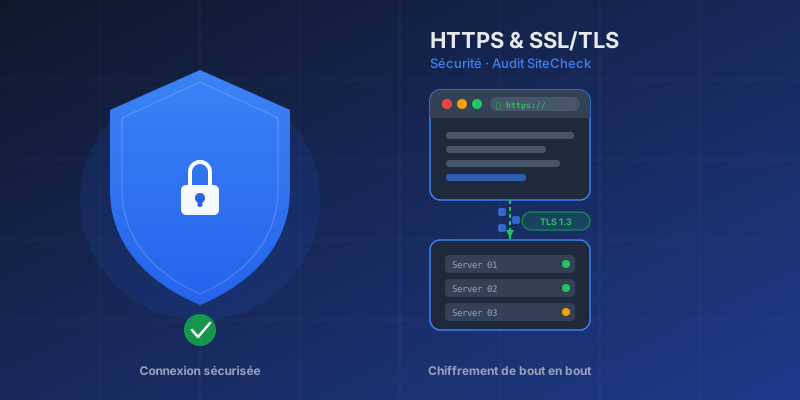
The padlock in your browser’s address bar is far more than a visual detail. It signals HTTPS, a fundamental security layer that every website should have.
What Are HTTPS and SSL/TLS?
HTTPS (HyperText Transfer Protocol Secure) is the encrypted version of the standard HTTP protocol. It relies on SSL/TLS (Secure Sockets Layer / Transport Layer Security), a cryptographic system that protects data exchanged between your visitors’ browsers and your server.
In practice, when a user fills in a contact form or places an order on your site, their information travels through dozens of servers before reaching its destination. Without HTTPS, that data travels in plain text and can be intercepted or altered by a malicious third party — a so-called man-in-the-middle attack.
Why Google Cares
Since 2014, Google has included HTTPS as a ranking signal in its search algorithm. A secured site gains an advantage over an otherwise equivalent unsecured one. More critically, modern browsers like Chrome now display a “Not Secure” warning for all HTTP pages, which significantly damages perceived credibility and conversion rates.
Beyond the Certificate: HSTS and Security Headers
Having an SSL certificate is just the first step. For optimal protection, your site should also implement:
- HSTS (HTTP Strict Transport Security): forces browsers to use HTTPS exclusively for all future visits, even if the user types “http://” directly
- Content-Security-Policy: restricts the resources your page can load to prevent XSS injections
- X-Frame-Options: prevents your site from being embedded in an iframe (protection against clickjacking)
- X-Content-Type-Options: blocks MIME type sniffing by the browser
Mixed Content: The Migration Pitfall
A common mistake when migrating to HTTPS: leaving resources (images, scripts, CSS) loaded over HTTP. These “mixed content” issues partially undermine the protection HTTPS provides and trigger browser warnings. Modern browsers silently block some mixed resources, which can visually break your site without an obvious warning.
How to Check Your Site’s Status
A thorough audit covers not only the presence of a valid SSL certificate, but also its expiration date, HSTS configuration, security headers, and the absence of mixed content. These checks are part of the 20 security checkpoints included in the 95 verifications performed by SiteCheck during a full audit.
Don’t let your site sail without a safety net — a well-executed HTTPS migration takes less than an hour and permanently protects your visitors and your search rankings.